|
I try to keep track of all of the output from the garden. I'm interested to see how much a small edible forest garden can produce on a domestic scale and in particular how long it takes for the garden to develop to its full potential. There are lots of other great things about growing a forest garden, but when I was planning my garden I found it difficult to get numbers on productivity. Hopefully these records might be useful to someone else going through that process.  The plot above shows the total output from the front and backgarden over the last five years. The results are dominated by a major harvest of potatoes in 2011 when I turned the whole of the front garden over to growing them to clear it. 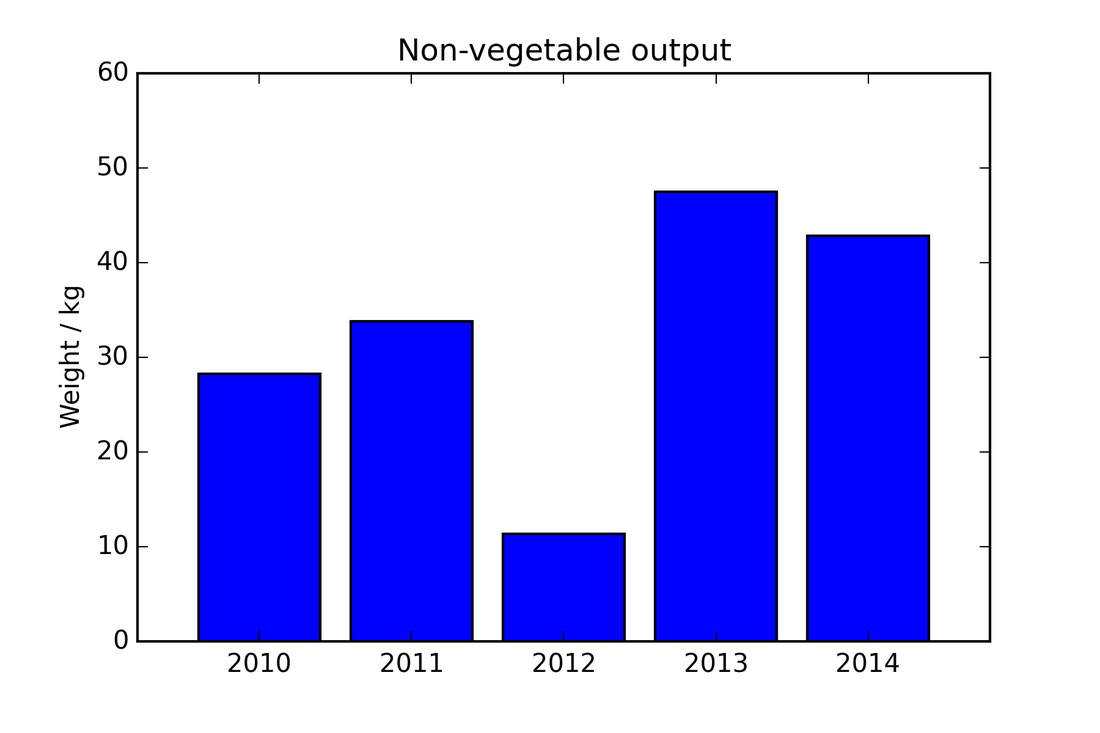 The next plot shows the total output, not including the vegetables. This starts to make more sense now. The output in 2012 was particularly bad, but the trend is for a gradual increase since planting in 2008, although 2014 has been down a little on last year. The apple harvest this year was very poor, only 5.1 kg compared to 13.7 kg last year. Most of the apples this year were from the early Redsleeves with the others failing. I have heard others say that it was a poor year for apples in general. In addition, I grafted over the last third of a remaining apple tree and the earlier grafts are still too young to be in production. The two standard apples are also not really fully mature yet, although they did produce well last year. Pears were also down a little from 5.3 kg to 3.7 kg. This year saw did see quite a lot of mulberries though, a promise of more to come as the tree gets bigger. 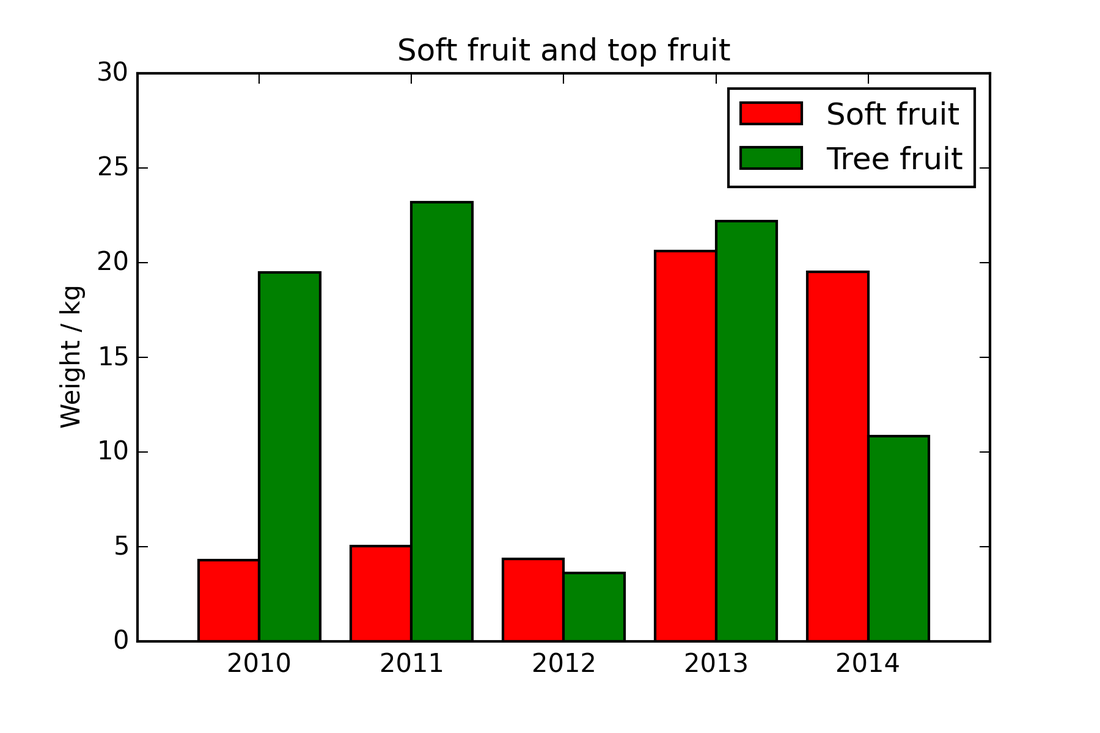 The next plot breaks down the fruit production into tree fruit (top fruit) and soft fruit. This makes clear that the tree fruit definitely took a hit this year. The soft fruit was about the same as last year. Raspberries were by far the most prolific (8.4 kg), then redcurrants (2.5 kg), blackcurrants (1.3 kg) and loganberries (1.2 kg). The garden produced lots of variety of fruit in quantities around a kilo. A nice surprise was the Japanese Wineberry which yielded 0.47 kg, which is a lot of the very small berries! The total fruit output was down this year compared to last, but the hazelnut harvest was a real succes, up from 1.8 kg to 6.1 kg. Rhubarb also did well, up from 3.9 kg to 7.1 kg. 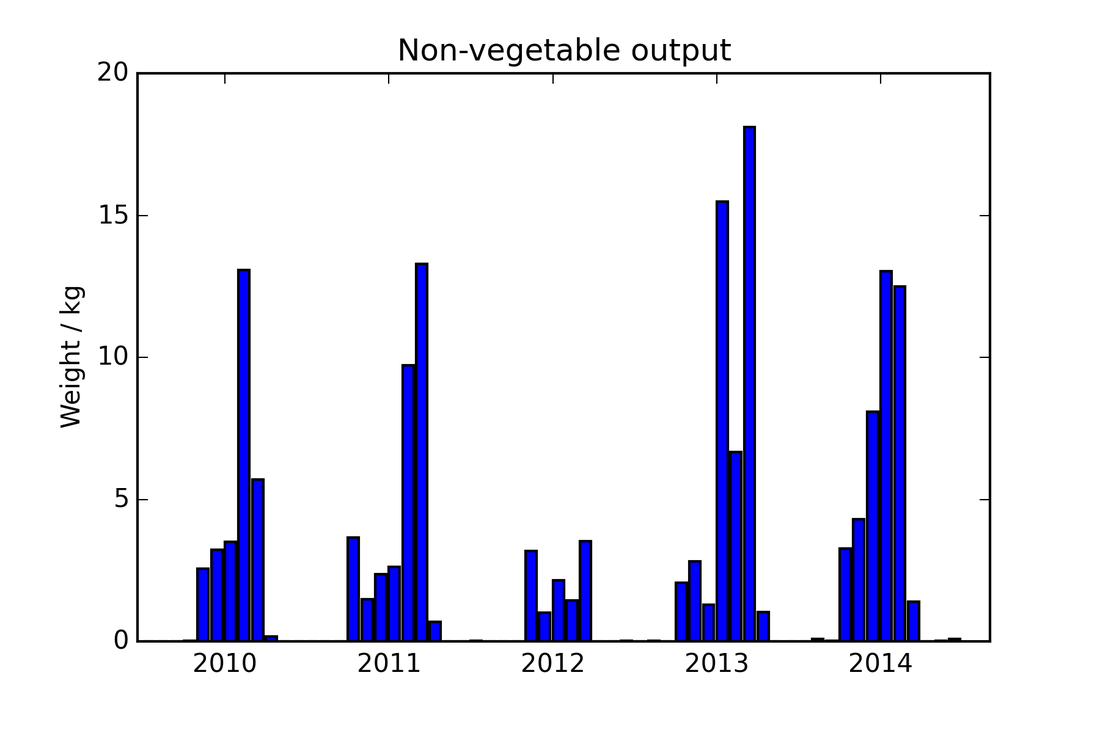 This year was characterised by very early soft fruit harvest, with about half of the raspberry crop coming in June. The plot above shows the breakdown by month. It shows a slightly more even distribution than previous years. My hope is that as the fruit trees mature the later part of the year will start to fill in. The polytunnel will also extend the production later in the year and in the early months. It's already producing a lot more salad than last January. 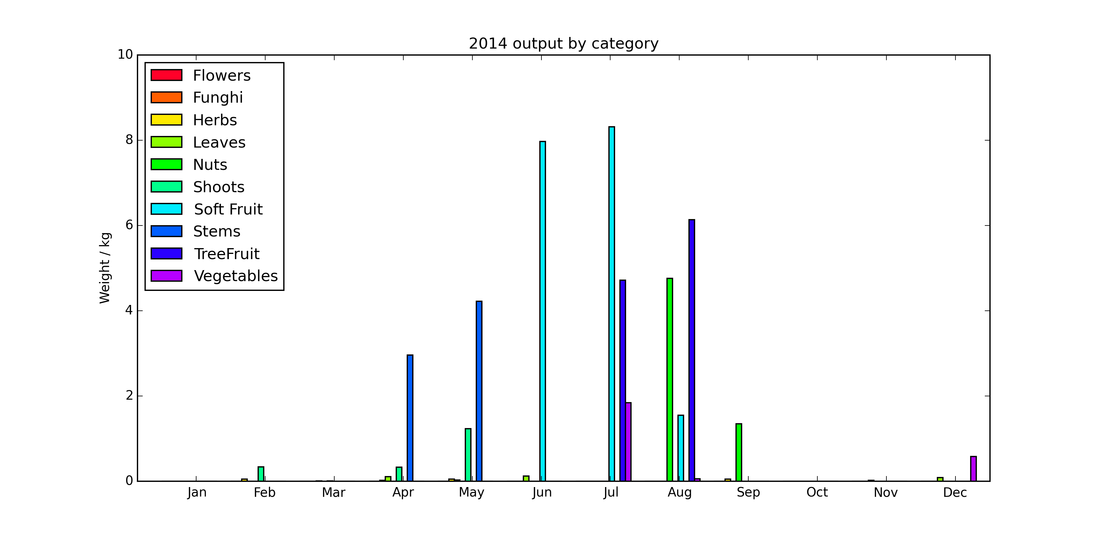 The last plot shows how the different crops have been harvested through the year. Garlic and Babbington leeks are some of the first crops, then rhubarb, followed by the soft fruit then the top fruit and nuts. The last harvest in December was of some potatoes and oca from the polytunnel. This isn't the whole story of course. Last year, when the apple harvest was better there was fruit to store into the winter months, extending the time when produce was available. This year, it is only frozen soft fruit and hazelnuts that have made it this far, but they are definitely welcome.
0 Comments
It feels like it has been a long time coming, but finally there is fruit in the garden. I've been harvesting salad for a quite a while now from the raised beds, but as of last week I got a nice surprise - lots of the fruit on the blackcurrant Ebony had ripened. Since then the garden hasn't looked back. There have been a few gooseberries, more blackcurrants and now lots of raspberries. The Glen Ample variety I put in a couple of years ago has been steadily cropping with lots of large well flavoured fruit. I've been picking most days and today got more than 350 g and there are only three large canes. The other raspberries are starting to ripen now so hopefully there will be a continuous supply for weeks to come.
There are lots of other promising looking fruit this year, with apples on all the trees including the first fruit on the Blue Pearmain double cordon. The sweet cherry is also covered in fruit that is nearly ripe. One other great surprise was to find the first few mulberries on the black mulberry tree. I had read that they could take up to seven years to fruit so its exciting to see it fruiting after four years. I'll post some pictures soon. The design and implementation of my forest garden has been top down. I planned the canopy trees and planted those in the first and second year. Some of the fruit bushes were planted at the same time and others followed later. However, a lot of the herbaceous layer wasn't really planned at the same time but I've been working on a few patches recently. My plan is to try out different combinations and see how they work together. At the back of the garden near the compost heaps I have a patch of autumn fruiting raspberries that were slow to establish but are now growing really well. They are close to another area of summer fruiting raspberries and the two are merging together. I also have some sweet cicely hiding behind them in a shady corner. I planted some lemon balm last year in front of the raspberries and it has spread and grown strongly this year. The lemon balm spread out horizontally last autumn and the raspberries sent shoots up through it. The lemon balm has now put on lots more height and they appear to complement each other, although I will wait to see if the lemon balm is shaded out by the raspberries too much. There is also some salad burnet and peppermint that makes up the front of the patch. I took a video of the patch developing in the middle of May which has some labels showing the different plants. Only part of the picture is in focus, but hopefully you can see the range of different plants. Last winter I cut down the large Leylandii trees at the end of the garden. I shredded most of the cuttings at the time, but was left with a large pile that I never got around to sorting out. Since then they had started to rot down where I left them. I recently cleared them up - shredded some for mulch and saved the stems for firewood. It left me with a small patch free to plant.
The area is behind the sour cherry tree so gets some shade and is close to the kids climbing frame so gets some foot traffic. I decided to expand the shrub layer and also add an extra tree. Inspired by Martin Crawford's garden at the Agroforestry Research Trust, I chose a small-leaved lime (Tilia cordata) to go in the middle. These trees have edible leaves and at ART the tree is pollarded to keep the size manageable. I will probably do something similar, although it will be a while before it needs cutting. For the shrub layer I planted an Aronia berry (chokeberry Aronia melanocarpa), a jostaberry (Ribes x culverwellii), a whitecurrant (Blanka) and three raspberries (Glen Moy Rubus idaeus). I plan to let the raspberries spread across the area as they grow. In between the plants I have left some of the composed Leylandii as a rough mulch. I plan to carry on planting in between with ground covers later in the year. Whilst I was planting I also dug up one of the sorrel plants in the garden and split it. It was hard work splitting the roots as they were pretty tangled, but eventually I got two good sized pieces and a third smaller one. Hopefully they will all survive. |
AboutA blog following the development of a small edible forest garden in Salisbury, Wiltshire, first planted in winter 2008.
 AuthorA forest gardening enthusiast with an interest in growing food sustainably, locally and with minimal effort.  More blogsAnni's Perennial Veggies
Bangor Forest Garden Project Forest Garden Plants Fruit Forum Graham Burnett Have Some Pi Help Save Bees Il Giardino Foresta Maddy Harland Moulsecoomb Forest Garden Mortal Tree Oak House Permaculture Project Of Plums And Pignuts Otter Farm PermaculturePower PermieHomestead Plants for a Future Plant Trees, It's Self Defence Really Useful Gardens SelfSufficientish Southwoods Forest Gardens Sustainable Forest Garden Farm Project The Cultural Wilderness The Field The Unconventional Gardener Transition Culture Two Go Forest Gardening Wiltshire Wildlife Trust Food Champions Ynysmon's Blog Other links
Check out the resources page for lots more forest gardening websites, books and videos.
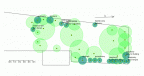
Details of my young forest garden are here and photos here.  Produce 20161 Jan - 31 Mar
0.640kg Babington leek 0.417kg Cabbage 0.742kg Celeriac 0.005kg Coriander 0.343kg Daikon 0.003kg Fennel 0.091kg Garlic shoots 0.005kg Goji berry leaves 0.259kg Lettuce 0.002kg Mint 0.020kg Pak choi 0.233kg Parsley 2.100kg Potatoes 0.041kg Radish 0.006kg Red veined sorrel 2.069kg Rosemary 0.888kg Ruby chard 0.002kg Thyme 0.065kg Winter purslane 1 Apr - 30 Jun 0.008kg Alpine strawberries 0.555kg Babington leeks 0.003kg Basil 0.989kg Beetroot 1.987kg Celeriac 0.019kg Chillis 0.076kg Chives 0.466kg Cleavers 0.227kg Coriander 0.075kg Courgettes 0.034kg Fennel 0.045kg Garlic shoots 0.004kg Gooseberries 0.048kg Holly leaves 0.006kg Lemon balm 0.541kg Lettuce 0.005kg Lime leaves 0.012kg Mint 0.108kg Nettles 0.440kg Oca 0.295kg Parsley 0.003kg Radish 0.241kg Raspberries 2.570kg Rhubarb 0.052kg Rocket 0.001kg Rosemary 2.338kg Ruby chard 0.022kg Sage 0.099kg Spring onions 0.464kg Strawberries 0.001kg Sweet violet 0.064kg Wild garlic 0.001kg Winter purslane 1 Jul - 30 Sep 0.030kg Alpine strawberries 22.360kg Apples 0.003kg Basil 0.317kg Blackberries 0.706kg Blackcurrants 0.595kg Blueberries 0.085kg Chillis 0.002kg Chives 8.255kg Courgettes 0.003kg Fennel 0.205kg Gooseberries 2.674kg Hazelnuts 0.429kg Japanese wineberries 2.404kg Jostaberries 0.209kg Loganberries 0.025kg Mint 0.167kg Mulberries 0.006kg Nasturtium 0.004kg Parsley 4.068kg Pears 4.097kg Rapsberries 3.988kg Redcurrants 0.016kg Rocket 0.522kg Rosemary 0.026kg Spring onions 0.837kg Sweet cherries 0.234kg Tayberries 2.142kg Tomatoes 1.229kg Whitecurrants 1 Oct - 31 Dec 2.263kg Apples 0.317kg Chillis 2.697kg Courgettes 0.060kg Mashua 0.030kg Mint 0.250kg Oca 0.080kg Parsley 0.581kg Pears 1.360kg Potatoes 0.011kg Rocket 0.056kg Rosemary 0.050kg Sage 0.651kg Tomatoes Produce 20151 Jan - 31 Mar
0.187kg Babington's leek 0.031kg garlic shoots 0.005kg mint 0.560kg salad 1 Apr - 30 Jun 0.021kg alpine strawberries 2.074kg Babington's leeks 0.017kg basil 0.975kg blackcurrants 0.434kg cabbage 0.016kg chives 0.095kg coriander 0.009kg dill 0.156kg garlic shoots 0.443kg gooseberries 1.801kg kohlrabi 0.297kg lettuce 0.015kg lime leaves 0.035kg mint 0.033kg mustard leaves 0.231kg nettles 0.089kg onion 0.470kg oregano 0.013kg pak choi 0.013kg parsley 0.626kg peas 0.107kg peppermint 0.871kg purple sprouting broccoli 4.219kg raspberries 1.406kg red onion 0.048kg red-veined sorrel 1.751kg rhubarb 1.618kg ruby chard 0.324kg spring onion 1.157kg strawberries 0.577kg sweet cherries 0.242kg tayberried 0.001kg thyme 0.160kg wild garlic 0004kg winter purslane 1 Jul - 30 Sep 0.003kg alpine strawberries 0.002kg apple mint 37.964kg apples 0.033kg basil 0.753kg blackberries 7.207kg blackcurrants 2.441kg blueberries 0.073kg cabbage 0.039kg celeriac 0.019kg coriander 6.329kg courgettes 15.960kg cucumber 0.012kg dill 0.466kg french beans 0.312kg garlic 1.447kg gooseberries 12.822kg hazelnuts 0.967kg Japanese wineberries 2.390kg jostaberries 0.205kg lettuce 0.001kg lime basil 0.848kg loganberries 0.018kg mint 0.203kg mulberries 0.005kg oregano 0.041kg pak choi 0.004kg parsley 2.010kg pears 0.006kg peppermint 8.529kg raspberries 6.138kg redcurrants 0.005kg rocambole 2.198kg ruby chard 0.024kg sage 1.605kg sour cherries 0.191kg strawberries 0.843kg strawberries 0.651kg tayberries 0.001kg thyme 15.138kg tomatoes 0.977kg whitecurrants 1 Oct - 31 Dec 0.117kg chilli peppers 0.018kg coriander 0.022kg courgettes 6.716kg cucumbers 0.008kg dill 0.223kg french beans 0.115kg hazelnuts 0.025kg lettuce 0.002kg mint 0.065kg parsley 0.524kg pears 1.412kg ruby chard 0.072kg spring onion 6.489kg tomatoes Produce 2014
1 Jan - 31 Mar
0.308kg Babington leeks 0.034kg garlic shoots 0.001kg parsley 0.004kg red veined sorrel 0.011kg rosemary 0.025kg sage 0.016kg thyme 1 Apr - 30 Jun 0.010kg alpine strawberries 1.350kg Babington leeks 0.104kg blackcurrants 0.012kg chives 0.210kg garlic shoots 0.092kg gooseberries 0.006kg lemon balm 0.529kg loganberries 0.015kg oregano 0.006kg parsley 0.035kg peppermint 5.655kg raspberries 0.177kg redcurrants 0.051kg red veined sorrel 7.180kg rhubarb 0.120kg salad 0.006kg salad burnet 0.896kg strawberries 0.509kg tayberries 0.084kg wild garlic 1 Jul - 30 Sep 5.121kg apples 0.008kg alpine strawberries 0.857kg blackberries 1.190kg blackcurrants 0.904kg blueberries 1.840kg garlic 6.102kg hazelnuts 0.467kg Japanese wineberries 0.716kg loganberries 0.313kg mulberries 3.742kg pears 2.752kg raspberries 2.349kg redcurrants 0.054kg rocambole 0.050kg sage 1.655kg sour cherries 0.021kg sweet cherries 0.298kg tayberries 0.242kg whitecurrants 0.078kg worcesterberries 1 Oct - 31 Dec 0.113kg salad 0.382kg oca 0.200kg potatoes Produce 2013
1 Jan - 31 Mar
0.024kg garlic shoots 1 Apr - 30 Jun 0.326kg Babbington leeks 0.222kg blackcurrants 0.363kg garlic shoots 0.147kg gooseberries 0.002kg lemon balm 0.121kg lettuce 0.004kg lime leaves 0.058kg mizuna 0.121kg oregano 0.010kg pea shoots 0.015kg peppermint 0.223kg raspberries 0.020kg red veined sorrel 3.900kg rhubarb 0.400kg salad 0.005kg salad burnet 0.008kg shitake mushrooms 0.076kg strawberries 0.013kg thyme 0.136kg wild garlic 1 Jul - 30 Sep 0.101kg alpine strawberries 13.653kg apples 0.276kg blackberries 2.816kg blackcurrants 1.380kg blueberries 0.159kg broad beans 0.965kg courgettes 1.340kg garlic 1.808kg hazelnuts 0.118kg Japanese wineberries 0.493kg loganberries 0.008kg mulberries 4.368kg pears 0.036kg peppermint 1.143kg potatoes 0.063kg quince 9.226kg raspberries 0.699kg redcurrants 0.223kg rocambole 0.150kg salad 1.448kg sour cherries 0.064kg spearmint 0.660kg spring onions 0.863kg strawberries 1.622kg sweet cherries 0.156kg tayberries 0.721kg whitecurrants 0.010kg worcesterberries 1 Oct - 31 Dec 0.938kg pears 0.095kg quince 0.091kg oca 0.242kg mashua Produce 2012
1 Jan - 31 Mar
0.050kg fennel 0.009kg garlic shoots 0.030kg goji berries 0.050kg rocket 1 Apr - 30 Jun 0.004kg alpine strawberries 0.480kg cabbage 0.323kg garlic shoots 0.050kg lemon balm 0.002kg loganberries 0.050kg mint 0.402kg mushrooms 0.360kg potatoes 0.730kg raspberries 0.030kg red veined sorrel 0.130kg redcurrants 4.000kg rhubarb 0.540kg rocket 0.020kg sorrel 0.134kg strawberries 0.007kg tayberries 01 Jul - 30 Sep 0.020kg alpine strawberries 0.180kg apples 0.552kg blackberries 0.178kg blackcurrants 0.711kg blueberries 1.020kg garlic 0.201kg gooseberries 0.263kg hazelnuts 0.051kg Japanese wineberries 0.028kg loganberries 3.354kg pears 1.610kg potatoes 0.910kg raspberries 0.353kg redcurrants 0.063kg sour cherries 0.049kg strawberries 0.014kg tayberries 0.192kg whitecurrants 1 Oct - 31 Dec 7.690kg Jerusalem artichokes 0.211kg oca 0.010kg peppermint 0.820kg potatoes 0.010kg thyme Produce 2011
1 Jan - 20 Mar
Firewood Rosemary Sage Chives Salad burnet 21 Mar - 31 May 0.035kg chives 0.070kg lemon balm 0.005kg nasturtium leaves 0.017kg raspberries 4.060kg rhubarb 0.060kg rocket 0.020kg rosemary 0.280kg sage 0.070kg salad burnet 0.050kg sorrel 0.065kg spearmint 0.429kg strawberries 0.012kg sweet fennel 0.003kg tayberries 0.010kg thyme 1 Jun - 31 Aug 35.2kg 29 different crops: 0.030kg alpine strawberries 8.884kg apples 0.492kg beetroot 0.258kg blackberries 0.377kg blackcurrants 0.337kg blueberries 0.010kg chives 7.095kg courgettes 0.001kg fennel 0.946kg garlic 1.481kg hazelnuts 0.001kg Japanese wineberry 0.007kg lemon balm 0.005kg mashua leaves 0.004kg nasturtiums 0.100kg pears 0.005kg peppermint 11.920kg potatoes 1.130kg raspberries 0.262kg redcurrants 0.005kg rocket 0.064kg salad burnet 0.460kg sour cherries 0.024kg spearmint 0.558kg strawberries 0.311kg sweet cherries 0.086kg tayberries 0.087kg whitecurrants 1 Sep - 31 Dec 11.633kg apples 0.040kg aronia berries 1.299kg beetroot 0.036kg blackberries 2.472kg courgettes 0.034kg hazelnuts 6.205kg Jerusalem artichokes 4.250kg mashua 1.801kg pears 37.135kg potatoes 0.371kg raspberries 0.024kg strawberries 0.044kg whitecurrants Produce 2010
A record of produce from the garden in 2010. I expect this list to get much longer in later years.
1 Jan - 20 Mar 2010: Firewood - kindling and small logs for wood burner Herbs - rosemary Vegetables - 5 leeks Greens - Handfull of sorrel, salad burnet and dandelions. 21 Mar - 4 Jun 2010 3.600kg rhubarb 0.250kg sorrel rosemary salad burnet mint chives rocket a few strawberries 5 Jun -> 1.120kg garlic 1.063kg raspberries 3.430kg rhubarb 0.165kg strawberries 0.104kg sweet cherries 0.065kg tayberries 0.130kg gooseberries 0.029kg alpine strawberries 0.100kg loganberries 1.710kg sour cherries 0.486kg blackberries 0.039kg blackcurrants 0.220kg blueberries 3.264kg courgettes 0.240kg lettuce 8.375kg pears 3.820kg potatoes 9.300kg apples 0.076kg hazelnuts See archives from October 2009 below for last year's produce.  Archives
June 2023
 Categories
All
|
 RSS Feed
